How AI Is Transforming Corporate E-Learning: Three Tools That Change Everything
For over a decade, corporate e-learning has followed the same formula: build a module, deploy it, collect completion rates, and move on. Maybe update the content once a year. Maybe run a survey that tells you learners thought it was “good.”
But here’s the uncomfortable truth: completion rates don’t tell you whether anyone actually learned anything. And a five-star rating doesn’t tell you what to improve.
At Capytech, we’ve spent the last thirteen years building custom e-learning for organisations across the Middle East. We’ve worked with everyone from Cartier to DP World and First Abu Dhabi Bank. And over that time, we’ve seen the same gaps appear again and again: learners get stuck with no support, feedback is shallow, and there’s no way to assess whether someone can actually apply what they’ve been taught.
So we built three AI tools to fix that. They sit directly inside our e-learning modules, and they’re fundamentally changing how our clients think about training.
1. AI Tutor: Support at the Point of Learning
The most critical moment in any learning experience is when a learner gets confused and doesn’t know where to turn. Traditionally, they’d either skip ahead, re-read the same content, or give up entirely. None of those outcomes are good.
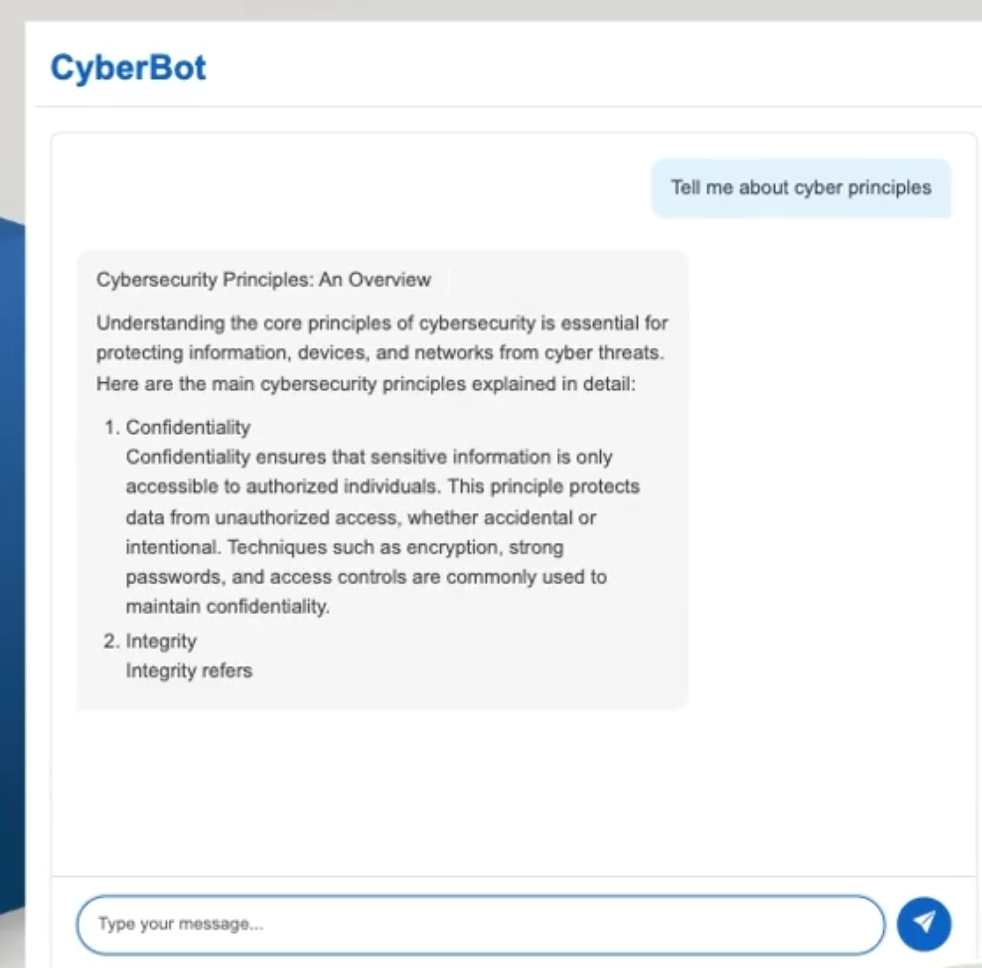
Our AI Tutor changes that. It’s embedded directly within the e-learning module, a simple chat interface where learners can ask questions as they go. But unlike a generic chatbot, it’s trained specifically on the learning content you’ve developed. Ask it about least privilege in a cyber security module, and it gives you an answer grounded in the material your organisation has approved.
Multilingual by default
This matters enormously in our region. A learner can ask a question in Arabic and receive a fluent, accurate response in Arabic. Another learner on the same module can ask in English. No separate builds, no additional translation costs, one module serves your entire multilingual workforce.
Full visibility for L&D teams
Every question is captured anonymously. Your L&D team gets a dashboard showing what’s being asked, which topics generate the most questions, and, critically, the ability to QA every response the AI gives. You can see exactly what the AI said and whether it hit the mark.
This creates something that didn’t exist before: real-time insight into what your learners find most challenging, based on their actual behaviour rather than what they tell you in a survey.
2. Reflect AI: Feedback That Actually Means Something
We’ve all seen the feedback. “The module was really great and informative.” It’s polite. It’s useless.
The problem isn’t that learners don’t have opinions, it’s that traditional surveys don’t ask the right questions, and they certainly don’t follow up. A Likert scale can’t probe deeper when someone says the content was “fine.”
Reflect AI can. Deployed at the end of a module (either embedded or through your LMS), it has a genuine conversation with the learner. When someone says the module was great, it asks what specifically they found great. It asks about the concepts covered, whether they felt relevant, and what could be improved. The conversation continues naturally until it reaches a meaningful conclusion.
From feedback to action
All of this feedback is then summarised by AI, across individual learners and entire cohorts. Your L&D team gets an instant overview of what’s working and what isn’t, without manually reading through hundreds of responses.
The result? You can update and improve your training content in days rather than waiting for the annual review cycle. The feedback loop becomes continuous, and your training gets measurably better with every cohort that goes through it.
Scenario Coach: Proving Learners Can Apply What They’ve Learned
This is our newest tool, and frankly, it’s the one that excites us the most.
Knowing something and being able to do something are very different things. A learner might score perfectly on a knowledge check about managing difficult conversations, but freeze when they’re actually sitting across from an underperforming team member. Traditional e-learning has no way to bridge that gap.
Our Scenario Coach creates realistic, interactive role-play scenarios powered by AI. The learner engages in a conversation with an AI character, say, a team member called Nadia who’s been missing deadlines and creating tension in the team. The AI character responds naturally, reacts to tone and approach, and the conversation unfolds based on the learner’s choices.
Real-time assessment
As the conversation progresses, the system tracks everything:
– **Mood progression**: is the AI character becoming more open or more defensive based on the learner’s approach?
– **Checklist tracking**: is the learner hitting the key competency points they should be addressing?
– **Tone analysis**: how is the learner’s communication style affecting the outcome?
Detailed performance feedback
At the end of the scenario, the learner receives a comprehensive breakdown: an overall rating, specific strengths, areas for improvement, and a skills assessment mapped to whatever competency framework you’ve defined. Managers can review the same data.
This works brilliantly for:
– Leadership development: practising difficult conversations, coaching, performance reviews
– Customer service: handling complaints, de-escalation, service recovery
– Sales training: objection handling, consultative selling, negotiation
– HSE and compliance: safety interventions, incident reporting conversations

The Bigger Picture: Data-Driven Learning
What ties all three tools together is data. Every interaction across the AI Tutor, Reflect AI, and Scenario Coach is captured and analysed. For the first time, L&D teams have genuine insight into:
– What learners are struggling with (not what they say they’re struggling with)
– Whether the training content is actually effective
– Whether learners can apply what they’ve learned in realistic situations
This shifts the conversation from “did people complete the training?” to “did the training actually work?”, which is the question that matters.
Built for the Middle East
We’ve been operating in the UAE and wider GCC since 2013. Arabic and English content is standard for us, not an afterthought. We understand the cultural nuances, the regulatory landscape, and the specific challenges of training diverse, multilingual workforces in this region.
Every solution we build is fully bespoke and fully owned by our clients. We don’t do off-the-shelf, and we don’t do templates. Your AI tools are trained on your content, branded to your organisation, and tailored to your specific learning objectives.
See It in Action
We recently recorded a walkthrough demo of all three tools. If you’d like to see them in action, or better yet, discuss how they could work for your organisation, we’d love to hear from you.
Get in touch at [www.capytech.com](https://www.capytech.com) or connect with me directly on LinkedIn.